Pool Doctors Uganda LtdPool Doctors Uganda Ltd
Mail to us
+256 (0)393 217 410
8am - 6pm
Rm D04

Pool maintenance Checklist

What You Actually Need to Self-Maintain a Pool (2026)

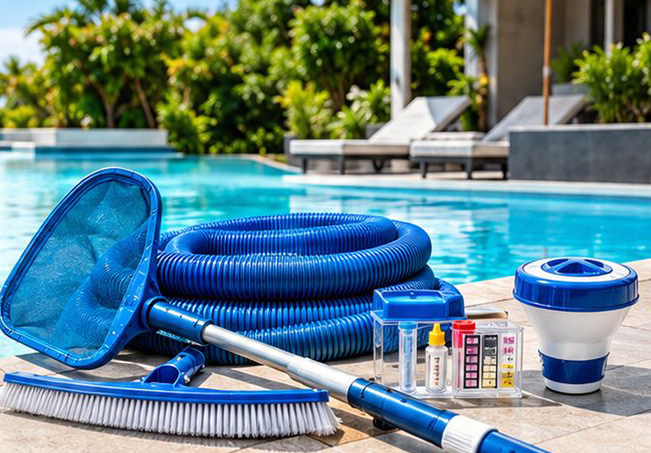
What You Actually Need to Self-Maintain a Pool (2026) – Pool Doctors Uganda Ltd Pool Equipment · Owner’s Guide What You Actually Need to Self-Maintain a Pool (2026) By Pool Doctors Uganda September 2026 6 min read Chemicals keep your water balanced. This is the physical equipment that actually does the cleaning, testing, and dosing, week to week, if you’re maintaining your own pool rather than using a service. Here’s what’s genuinely essential, what’s a worthwhile upgrade, and what’s overkill for most home pools. The Basic Toolkit Five things cover routine self-maintenance for most pools. Everything else on this page is an upgrade, not a requirement. TH Always needed Telescopic Handle The pole everything else attaches to. Adjustable length, aluminium construction. VH Always needed Vacuum Hose Connects your cleaning head to the filtration system. Length and duty rating should match your pool’s size and usage. SK Always needed Skimmer Net Daily surface debris removal. The fastest, cheapest maintenance habit that actually prevents bigger problems. FB Always needed Floor Brush For loosening debris and light buildup on pool surfaces before vacuuming. TK Always needed Test Kit You can’t self-maintain chemistry you’re not testing. A 3-way kit covers pool and spa; test liquids alone are the simpler option. Worthwhile Upgrades None of these are required to maintain a pool yourself. They save time, reduce manual work, or handle a specific recurring problem. WS Upgrade Wheel Sweeper Automates debris collection instead of manual brushing and vacuuming pass by pass. Available heavy and light duty. AB Upgrade — situational Algae Brush Stiffer bristles for scrubbing algae off surfaces. Only worth owning if algae is a recurring problem, not routine use otherwise. CD Upgrade — automation Floating Chemical Dispenser Slowly releases chlorine automatically instead of manual dosing between visits. SCG Upgrade — bigger investment Salt Chlorine Generator Converts salt to chlorine automatically, significantly reducing manual dosing. The largest upfront cost on this page, and the biggest reduction in ongoing manual work. Heavy Duty vs Light Duty: Which Sweeper? Light Duty Fine for smaller pools, or pools that don’t need daily attention. Fewer wheels, lighter build. Heavy Duty Built for bigger pools, rougher surfaces, or actual daily use. More wheels, more durable construction, holds up longer under real use. Buying heavy duty for a pool that doesn’t need it isn’t wrong. It’s just not necessary, the same logic applies to hose length and duty rating. Equipment Prices in Uganda (2026) Real pricing, updated as anything changes. Product Available Options Telescopic Handle (Aluminium) 8m, 5m, 3m Vacuum Hose, Heavy Duty 30m, 15m Vacuum Hose, Light Duty (Set) 15m, 12m Skimmer Rack/Net, Heavy Duty (Aluminium Frame) Standard Skimmer Rack/Net, Light Duty Standard Floor Brush 18″ Wire / Algae Brush 10″ Wheel Sweeper, Heavy Duty (Black) 12-wheel, 8-wheel Wheel Sweeper, Light Duty (Blue) 8-wheel Floating Chemical Dispenser (S.G Tech) Standard, Blue/White Salt Chlorine Generator SQ 50 Set Chlorine Feeders VTP 009 Medium Test Liquids / Solutions Pair 3-Way Water Test Kit (Pool & Spa) Set Key Takeaways Five items cover routine self-maintenance: handle, hose, skimmer, brush, and a test kit. Everything else is optional. Heavy duty isn’t automatically better, match the tool to your pool’s actual size and use. Algae brushes and chemical dispensers solve specific problems, they’re not universal requirements. A Salt Chlorine Generator is the biggest upfront cost here, and the biggest reduction in ongoing manual work, worth it if you want automation, not required if you don’t. Self-maintenance covers routine cleaning and testing. Equipment failures and persistent problems are still worth a professional visit. Get Equipped, Fast Real prices, no quote required. Orders typically delivered within 72 hours, subject to distance and logistics. Chat on WhatsApp Call +256 752 665528 Or message +256 752 665528 directly and type ORDER. Continue Reading → Why Is My Pool Turning Green in Uganda? 5 Causes and Fast Fixes → Swimming Pool Maintenance in Uganda: Complete Guide for Kampala Pool Owners → How Much Does a Swimming Pool Cost in Uganda? (2026 Complete Guide) → How to Choose the Best Swimming Pool Builder in Uganda → Sauna & Steam Bath Installation in Uganda: The Complete Guide (2026)
Read more

Why Is My Pool Turning Green in Uganda? 5 Causes and Fast Fixes (2026)

Why Is My Pool Turning Green in Uganda? 5 Causes and Fast Fixes (2026) | Pool Doctors Uganda Pool Maintenance · Problem Solving Why Is My Pool Turning Green in Uganda? 5 Causes and Fast Fixes (2026) By Pool Doctors Uganda May 2026 8 min read A green pool is one of the most common problems Pool Doctors Uganda is called to address — and one of the most misunderstood. Most pool owners in Kampala blame the pump, the filter, or the brand of chemicals they are using. In the vast majority of cases, none of these are the real cause. Green pool water is caused by algae. Algae grows for specific, identifiable reasons — and every one of those reasons is fixable. This guide covers the 5 most common causes of green pool water in Uganda, explains exactly why each one happens in our specific climate, and gives you the fast fix for each one. If your pool is green right now — start with Cause 1. Work through the list in order. By the time you reach the end of this article, you will know exactly what is wrong and exactly what to do about it. Before you read further: Do not drain your pool. A green pool almost never needs to be drained. Draining wastes water, risks your pool shell cracking if the water table is high, and the algae returns immediately if the underlying cause is not addressed. Treat the water. Fix the cause. Draining is almost always the wrong answer. Why Green Pools Are More Common in Uganda Than Elsewhere Uganda’s climate creates specific conditions that make green pools more likely than in cooler or less sunny countries. Understanding these conditions helps you prevent the problem — not just fix it after it happens. Kampala sits close to the equator, which means intense UV radiation year-round. UV rays break down chlorine significantly faster than in cooler climates — a pool in Kampala loses its chlorine protection faster than an equivalent pool in London or Nairobi. Uganda also has two rainy seasons — March to May and October to November — during which heavy rainfall dilutes pool chemicals, drops pH, and introduces organic matter and contaminants from runoff. These two factors combined — high UV and seasonal heavy rain — mean that a Ugandan pool owner who follows generic pool maintenance advice written for other climates will almost certainly end up with a green pool at some point. 1 Cause 01 — Most Common Chlorine Level Has Dropped Below the Safe Threshold This is the cause of green water in the majority of cases Pool Doctors Uganda is called to address. When free chlorine drops below 1.0 parts per million (ppm), your pool loses its primary defence against algae. Algae spores are present in every pool — introduced naturally through rain, wind, and swimmers. They are invisible and harmless when chlorine is at the correct level. When chlorine drops, those spores begin multiplying. Within 24 to 48 hours in Uganda’s warm temperatures, a clear pool can become visibly green. The most common reason chlorine drops in Uganda is not that you stopped adding it — it is that the chlorine you are adding is being destroyed faster than you realise. Uganda’s direct equatorial sunlight breaks down unstabilised chlorine extremely rapidly. If you are using unstabilised chlorine in an outdoor pool, you may be adding the correct dose but losing it within hours of treatment. The Fast Fix Test your chlorine level immediately with a calibrated kit — not a colour strip. If free chlorine is below 1.0 ppm, shock the pool with a high-dose chlorine treatment (superchlorination). For ongoing prevention, switch to stabilised chlorine — it contains cyanuric acid that protects the chlorine from UV breakdown and lasts significantly longer in Uganda’s sunlight. Run the pump continuously for 24 hours after shocking. Urgency: Act today 2 Cause 02 pH Is Out of Range — Making Chlorine Ineffective This is the cause that surprises most pool owners. Your pool can have the correct chlorine level — test it and it reads 2.0 ppm, well within the safe range — and your pool will still turn green. How? Because if your pH is above 7.8, your chlorine becomes progressively less effective. At pH 8.0, chlorine is operating at roughly 20% of its normal effectiveness. At pH 8.5, it is essentially doing nothing. In Uganda, pH tends to rise after heavy rain because rainwater is naturally slightly alkaline. It also rises when pool water evaporates in direct sunlight and is replaced with fresh water. A pool owner who adds chlorine consistently but never tests or adjusts pH will find their pool turning green despite what appears to be correct chemical treatment. The Fast Fix Test your pH immediately. The correct range is 7.2 to 7.6. If pH is above 7.8, add pH Minus (sodium bisulphate or muriatic acid) in small doses, waiting 30 minutes between doses and retesting each time. Do not add large amounts at once — pH can drop past the correct range quickly. Once pH is back in range, your existing chlorine will begin working again immediately. If the pool is already green, shock treat at the same time. Urgency: Act within 24 hours 3 Cause 03 Blocked or Undersized Filter — Chemicals Not Circulating Your filter is your pool’s kidney. When it is working correctly, it circulates chemically treated water through every part of the pool continuously. When it is blocked or undersized for your pool’s volume, chemicals sit in concentrated pockets near the return jets while other areas of the pool receive little or no treated water. Algae grows in those untreated areas — typically the far corners of the pool floor and the areas behind steps or benches — and spreads from there. A blocked filter also means your pump is working harder than it should, increasing electricity consumption and shortening the pump’s lifespan. In Uganda’s dusty environment, filter media becomes blocked
Read more

Swimming Pool Maintenance in Uganda: Complete Guide for Kampala Pool Owners (2026)

Swimming Pool Maintenance in Uganda: Complete Guide for Kampala Pool Owners (2026) | Pool Doctors Uganda Pool Maintenance · Kampala Guide Swimming Pool Maintenance in Uganda: Complete Guide for Kampala Pool Owners (2026) By Pool Doctors Uganda April 2026 8 min read Owning a swimming pool in Kampala is one of the best decisions you can make for your property. But a pool that is not maintained properly stops being an asset and starts being a problem — fast. Green water, damaged tiles, failed equipment, and costly emergency repairs are not inevitable. They are almost always the result of maintenance that was skipped, delayed, or done incorrectly. This guide covers everything a Kampala pool owner needs to know about maintaining their pool in 2026 — weekly tasks, real costs, the right chemicals, seasonal adjustments, and the mistakes that turn small issues into expensive ones. It is written by the Pool Doctors Uganda team, who have been maintaining pools across Kampala and Uganda for over eight years. Why Pool Maintenance in Uganda Is Different Uganda’s climate creates specific maintenance challenges that standard pool guides written for Europe or North America do not account for. Understanding these factors is the first step to maintaining your pool correctly. Kampala sits close to the equator, which means intense UV radiation year-round. Ultraviolet rays break down chlorine significantly faster than in cooler climates — meaning a pool in Kampala needs more frequent chemical treatment than an equivalent pool in London or Dubai. Heavy rainfall during the rainy seasons dilutes your pool water, throws off your pH balance, and introduces contaminants from runoff. Red Kampala soil, dust, and organic debris from surrounding vegetation enter your pool constantly and consume your sanitiser. These are not problems you can solve by following the instructions on a chemical packet. They require a maintenance routine designed specifically for Uganda’s conditions. The 5 Weekly Maintenance Tasks Every Kampala Pool Owner Must Do Consistent weekly maintenance is the single most effective thing you can do to protect your pool investment. These five tasks should be completed every week without exception. Task 01 Test Your Water Chemistry Test chlorine, pH, and alkalinity at minimum once per week. In Uganda’s climate, twice per week is better. Use a reliable test kit — not just the colour strips, which are often inaccurate in high-UV environments. Task 02 Dose Your Chemicals Based on your test results, add the correct amount of chlorine, pH adjuster, and alkalinity balancer. Never guess quantities. Overdosing is as damaging as underdosing and far more common than pool owners realise. Task 03 Brush Walls and Floor Brush all surfaces including walls, floor, and steps weekly. Brushing breaks up algae forming on surfaces before it becomes visible. It also prevents scale buildup at the waterline and distributes chemicals more evenly. Task 04 Vacuum or Run Automatic Cleaner Remove settled debris from the pool floor. In Kampala, red soil and organic debris accumulate quickly. Left sitting, debris consumes chlorine and creates conditions where algae and bacteria thrive. Task 05 Check and Clean the Filter Check your filter pressure gauge. If pressure is 8–10 psi above the clean starting pressure, backwash the filter. A clogged filter cannot clean your water regardless of how many chemicals you add. Important: In Uganda’s high-UV environment, run your pool pump for a minimum of 8 hours per day. Many pool owners reduce pump hours to save electricity. This is a false economy — poor circulation is one of the leading causes of green water and algae growth in Kampala pools. Understanding Pool Chemicals: What You Actually Need Pool chemicals are not complicated, but using the wrong ones or the wrong quantities is one of the most common and costly mistakes Kampala pool owners make. Here is a straightforward breakdown of what each chemical does and why it matters. Chlorine Chlorine is your primary sanitiser. It kills bacteria, viruses, and algae. The correct free chlorine level for a residential pool in Uganda is between 1.0 and 3.0 parts per million (ppm). Below 1.0 ppm, your pool is unprotected. Above 3.0 ppm, it becomes an irritant to swimmers. In direct Kampala sunlight, chlorine burns off faster than anywhere else in the world — which is why stabilised chlorine products, which include cyanuric acid to slow UV breakdown, are preferable for outdoor pools here. pH Adjuster pH measures how acidic or alkaline your water is. The ideal range is 7.2 to 7.6. If pH is too low, chlorine becomes aggressively corrosive — damaging your equipment, tiles, and grout. If it is too high, chlorine becomes almost completely ineffective even when present at the correct level. Heavy rainfall consistently drives pH in Kampala pools toward the lower end of the scale. Check pH after every significant rain event. Alkalinity Balancer Total alkalinity acts as a buffer for your pH — it prevents pH from swinging up and down dramatically. The ideal range is 80 to 120 ppm. When alkalinity is too low, your pH becomes unstable and very difficult to control. This is one of the most overlooked aspects of pool chemistry in Uganda and a common reason why pool owners struggle to keep their chemistry balanced despite regular dosing. Algaecide A weekly maintenance dose of algaecide as a preventative measure significantly reduces the risk of algae outbreaks. This is especially important during the rainy season when organic matter entering the pool is at its highest. What Does Pool Maintenance Actually Cost in Kampala? The most common myth in Uganda is that pool maintenance costs UGX 500,000 per month. This figure is not accurate for a properly managed residential pool. Here are the real numbers: Maintenance Item Frequency Monthly Cost (UGX) Pool chemicals (chlorine, pH, algaecide) Weekly dosing 60,000 – 120,000 Professional service visit Weekly or bi-weekly 80,000 – 200,000 Electricity (pump running costs) Daily 50,000 – 100,000 Filter media replacement Annual (pro-rated) 15,000 – 30,000 Total Monthly Cost — UGX 205,000 – 450,000 The 500,000 shilling figure typically comes from pools
Read more

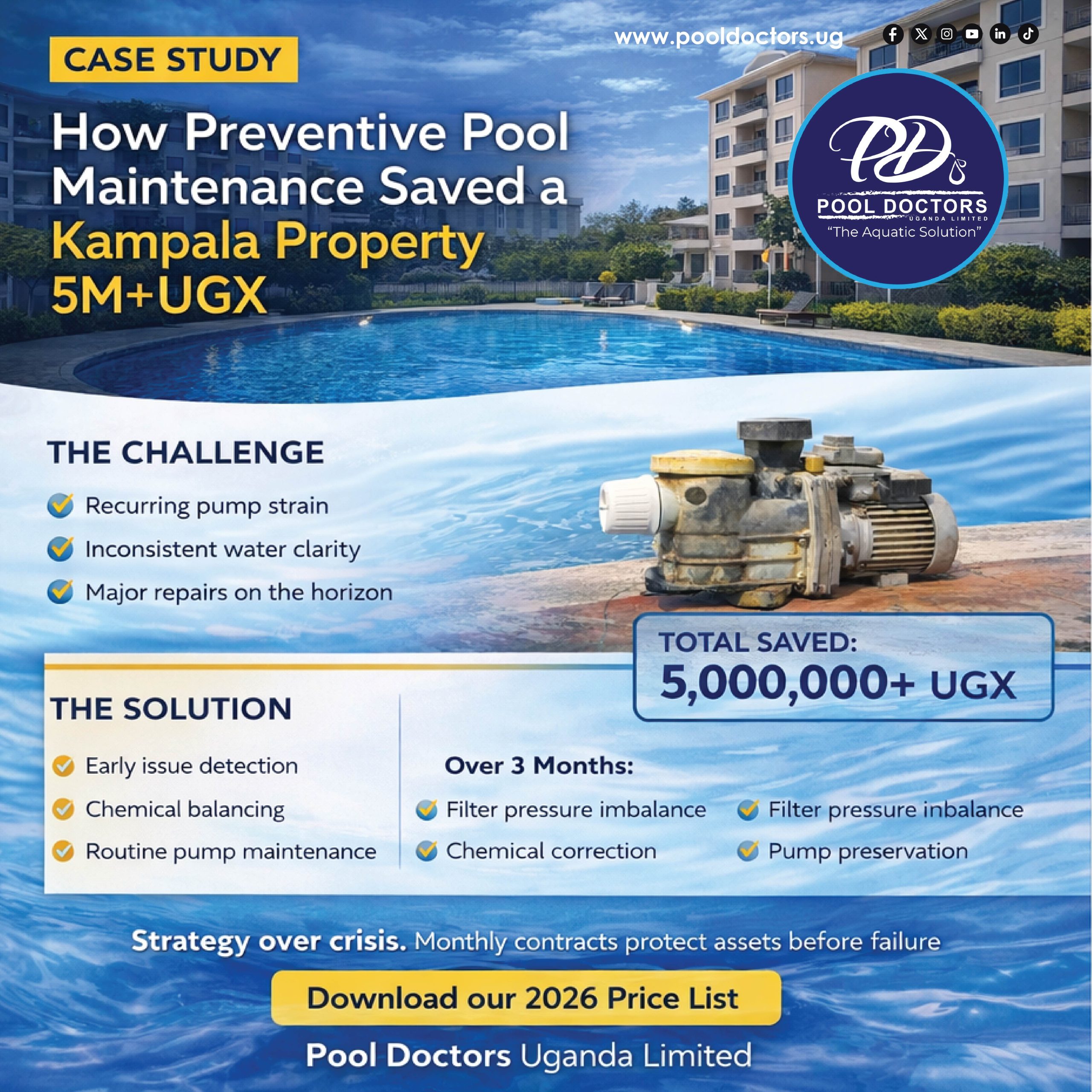
How Regular Pool Maintenance Saved a Kampala Property Over 5 Million UGX

Most pool owners in Uganda wait until something breaks before taking action.By then, the damage is already expensive. This case study shows how a property in Kampala avoided over 5 million UGX in repair costs by choosing preventive pool maintenance instead of reactive fixes. The Problem: Small Issues Turning Into Expensive Risks The client, a mid-sized residential apartment complex in Kampala, was experiencing: At this stage, most pool systems are weeks away from failure—and repair costs rise quickly. What Was Really Happening These symptoms pointed to deeper operational issues: Left unresolved, this would have resulted in: Estimated cost: 5M–8M UGX The Strategy: Preventive Maintenance Instead of Emergency Repair Instead of waiting for failure, the client adopted a monthly maintenance contract with Pool Doctors Uganda Limited. This included: The Result: Stability, Efficiency, and Cost Savings Within 3 months: Financial Impact By preventing system failure, the client avoided over: 5,000,000 UGX in repair and replacement costs Why Preventive Maintenance Is Always Cheaper Emergency repairs are expensive because: Preventive maintenance: Who Needs This Most in Uganda? This approach is critical for: If your pool is used frequently, maintenance is not optional—it’s financial protection. Key Takeaway You have two options: Most pool owners choose maintenance after a breakdown.Smart ones do it before. Protect Your Pool Before It Fails A clean pool is not just about appearance—it’s about: With the right maintenance plan, you avoid breakdowns, reduce expenses, and keep your pool in peak condition all year. If you manage a property or own a pool in Kampala: 📩 Download our 2026 Price List to explore structured maintenance plans📞 Or contact us directly on +256 752 665528 to schedule an inspection
Read more

Pool Maintenance After Rain in Uganda: 5 Essential Steps Every Pool Owner Must Take

Heavy rainstorms are common across Uganda, especially in urban areas such as Kampala where sudden downpours can quickly affect swimming pool water quality. While rainwater itself is clean, it dilutes pool chemicals, introduces debris, and disrupts water balance. If corrective action is not taken promptly, pool owners may experience cloudy water, algae growth, unsafe swimming conditions, and potential equipment damage. Understanding the correct maintenance steps after a storm helps protect your investment and ensures that your pool remains clean, safe, and functional. Below are five essential pool maintenance actions every Ugandan pool owner should take after heavy rain. Why Rain Affects Swimming Pools Rainfall changes the chemical balance of a pool in several ways: These changes can lead to bacterial growth, algae formation, and cloudy water, making the pool unsafe for swimmers if not addressed quickly. 1. Remove Debris Immediately Storms often leave leaves, insects, dust, and other organic materials floating on the surface of the pool. If debris remains in the water, it begins to decompose and consume chlorine, which is responsible for sanitizing the pool. What to Do Removing debris quickly prevents contamination and reduces strain on the filtration system. 2. Test and Rebalance Pool Chemicals Rainwater dilutes important chemical levels in a swimming pool. Without proper balance, the water may become unsafe or uncomfortable for swimmers. Important levels to check include: Chemical Level Ideal Range pH 7.2 – 7.6 Chlorine 1 – 3 ppm Total Alkalinity 80 – 120 ppm What to Do Use a professional pool testing kit to check chemical levels and gradually rebalance the water with appropriate chemicals. Maintaining proper chemical balance prevents algae growth and protects pool surfaces and equipment. 3. Run the Pump and Filtration System Rainwater introduces microscopic particles that may not be immediately visible. These particles cause water to appear cloudy or dull. Your pool pump and filtration system help remove these contaminants. Recommended Action After a storm: Proper filtration helps restore water quality faster and distributes chemicals evenly. 4. Inspect the Pump and Pool Equipment Storm debris can clog filtration systems and affect pump performance. Ignoring equipment inspection may lead to reduced circulation or mechanical failure. Key Areas to Inspect If the filter pressure increases significantly, it may be necessary to clean or backwash the filter system. Routine inspections help extend the lifespan of pool equipment. 5. Shock the Pool if Necessary If the pool water becomes cloudy, discolored, or contaminated, a chlorine shock treatment may be required. Shocking the pool involves adding a higher concentration of chlorine to eliminate bacteria, algae spores, and organic contaminants. When to Shock a Pool Shock treatments are most effective when performed in the evening, followed by several hours of filtration. Common Mistakes Pool Owners Make After Heavy Rain Many pool owners unintentionally make mistakes that worsen water conditions after a storm. Common errors include: Proper testing and gradual adjustments are essential for maintaining safe pool water. When to Call a Professional Pool Technician Maintaining correct pool chemistry requires experience and proper testing equipment. If the water remains cloudy or chemical levels become difficult to balance, professional assistance may be required. Pool Doctors Uganda Limited provides professional swimming pool maintenance services for residential properties, hotels, and commercial facilities in Kampala and surrounding areas. Our trained technicians assist with: Regular maintenance ensures that pools remain clean, safe, and operational throughout the year, regardless of weather conditions. Frequently Asked Questions Does rain affect chlorine levels in a swimming pool? Yes. Rainwater dilutes chlorine levels, which can reduce the pool’s ability to sanitize water and prevent bacteria growth. Should I shock my pool after heavy rain? In many cases, yes. If debris enters the pool or the water becomes cloudy, a chlorine shock treatment helps restore sanitation and clarity. How long should I run the pump after a storm? Most pools require 8–12 hours of filtration after heavy rain to circulate chemicals and remove contaminants. Can rain cause algae growth in pools? Yes. When chlorine levels drop after rain, algae can begin to grow quickly if the water is not properly balanced. Protect Your Pool Investment Swimming pools require consistent maintenance, particularly after heavy rainfall. By removing debris, balancing chemicals, and ensuring proper filtration, pool owners can prevent costly repairs and maintain safe swimming conditions. If you need professional assistance maintaining your swimming pool, Pool Doctors Uganda Limited provides expert pool care services designed to keep your pool in excellent condition year-round. Contact our team today to learn more about scheduled pool maintenance services in Kampala.
Read more

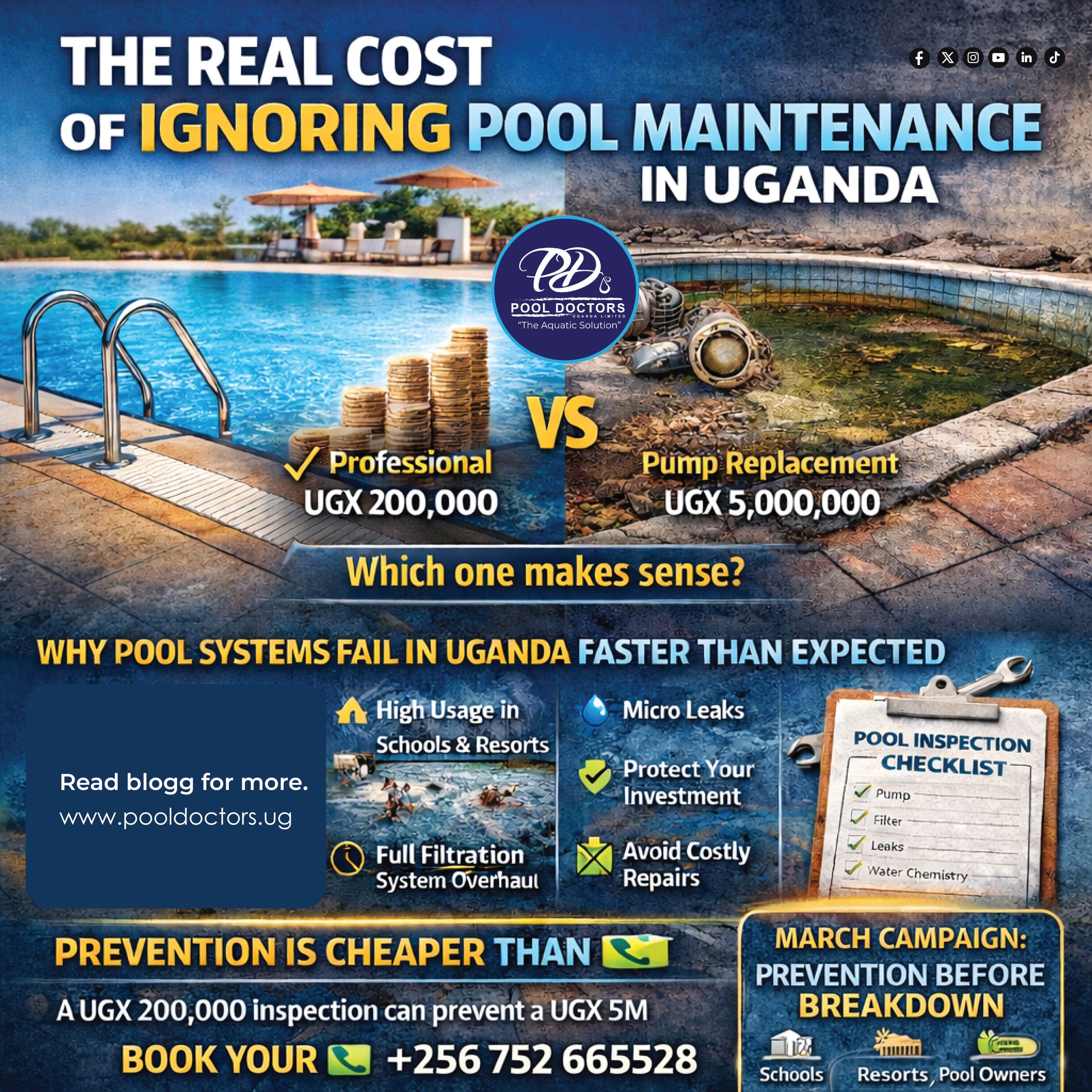
The Real Cost of Ignoring Pool Maintenance in Uganda

Swimming pools are long-term investments.But in Uganda, many pool systems fail prematurely — not because of age, but because of neglect. The difference between a properly maintained pool and a neglected one is not cosmetic. It is financial. And the numbers are not small. A Simple Comparison The question is simple: Which one makes sense? Why Pool Systems Fail in Uganda Faster Than Expected Uganda presents unique stress factors for pool systems: 1. Dust & Debris Load Dry seasons increase airborne dust and organic debris.Filters clog faster. Pumps work harder. Flow rates drop. 2. Power Fluctuations Voltage instability strains pump motors.Without routine inspection, minor overheating turns into total burnout. 3. High Usage in Schools & Resorts Pools in schools and hospitality facilities operate under heavy load: Without preventative servicing, equipment lifespan shortens dramatically. The Silent Killers of Pool Systems Most breakdowns don’t happen suddenly. They build slowly. Weak Flow Rate Often ignored.Usually a filter or pump strain issue. Unbalanced Water Chemistry Corrodes metal components internally.Damages heaters and pumps over time. Micro Leaks Increase motor runtime.Raise electricity bills quietly. Overworked Pumps When filters clog, pumps compensate by running harder.This increases wear and heat buildup. By the time the system “fails,”the damage has been happening for months. The True Financial Impact of Ignoring Maintenance Let’s look beyond equipment cost. For Resorts A cloudy or closed pool during peak season is revenue lost instantly. For Schools Pools in educational institutions carry responsibility.Maintenance is not optional — it is operational risk management. For Private Pool Owners Emergency repairs always cost more than planned inspections. Always. The Psychology Behind Maintenance Neglect Most owners delay inspection because: Clear water does not mean a healthy system. A pump can run while slowly destroying itself internally. Maintenance is invisible — until failure makes it visible. What a Professional Pool Inspection Actually Covers A proper inspection is not just a quick look. It includes: The goal is simple: Detect small issues before they become expensive problems. Prevention vs. Emergency Repair Preventative Maintenance: Emergency Repair: In business operations, predictable expenses are manageable.Unexpected ones damage cash flow. A Real Example Recently, a routine inspection revealed: The client was unaware. Without intervention, the pump would likely have failed within weeks. Instead of a UGX 5M replacement,the issue was resolved early at minimal cost. That is the power of prevention. The Long-Term Value of Maintenance Regular inspection: ✔ Extends equipment lifespan✔ Reduces electricity consumption✔ Protects water quality✔ Prevents emergency breakdown✔ Preserves brand reputation Maintenance is not an expense.It is protection of capital. March Campaign: Prevention Before Breakdown This March, we are offering a FREE Professional Pool Inspection to: Because prevention is cheaper than repair. And breakdowns are rarely sudden — they are ignored warnings. Final Question If a UGX 200,000 inspection can prevent a UGX 5M replacement… Which one makes sense? Book Your Inspection WhatsApp: +256 752 665528 Slots are limited this March. Protect your investment before failure forces you to react.
Read more

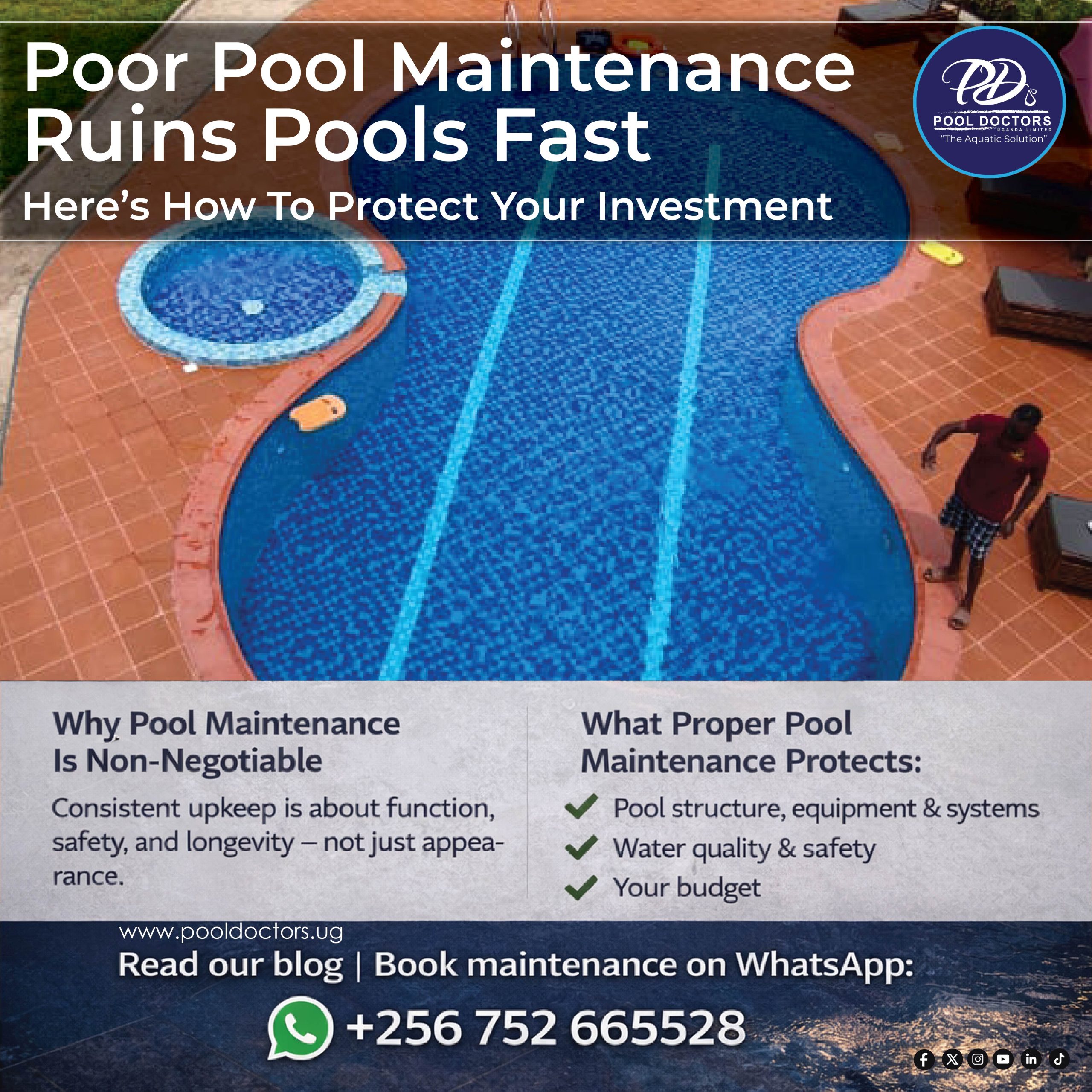
Poor Pool Maintenance Ruins Pools Fast — Here’s How to Protect Your Investmen

A swimming pool is not just a luxury feature — it’s a long-term investment. Yet many pool owners unknowingly shorten the lifespan of their pools through poor or irregular maintenance. What starts as a small issue can quickly turn into costly repairs, equipment failure, or even structural damage. At Pool Doctors Uganda Ltd, we’ve seen it first-hand: pools that could have lasted decades ruined in a few years due to neglect. Here’s what every pool owner needs to know — and how to protect your investment properly. Why Pool Maintenance Is Non-Negotiable Swimming pools operate under constant stress: Without consistent maintenance, these factors silently damage your pool system over time. Maintenance isn’t about appearance alone — it’s about function, safety, and longevity. Common Pool Maintenance Mistakes That Cause Serious Damage 1. Ignoring Water Chemistry Unbalanced water damages pool surfaces, corrodes fittings, and destroys equipment like pumps and heaters. It also creates unsafe swimming conditions. 2. Poor Filtration and Circulation When filters aren’t cleaned or pumps aren’t working efficiently, dirt and algae build up fast. This strains equipment and reduces water quality. 3. Delaying Small Repairs Minor leaks, loose fittings, or unusual pump noises are often ignored — until they become expensive system failures. 4. DIY Maintenance Without Expertise While basic cleaning helps, improper chemical dosing or incorrect handling of equipment often causes more harm than good. What Proper Pool Maintenance Protects ✔ Pool StructurePrevents cracks, leaks, and surface deterioration. ✔ Equipment & SystemsExtends the lifespan of pumps, filters, heaters, and control systems. ✔ Water Quality & SafetyKeeps water clean, balanced, and safe for swimmers. ✔ Your BudgetPreventive maintenance costs far less than emergency repairs or replacements. How Often Should a Pool Be Professionally Maintained? While daily or weekly visual checks help, professional maintenance should be scheduled regularly to: Residential and commercial pools have different needs — a professional assessment ensures nothing is overlooked. Why Work With Pool Doctors Uganda Ltd At Pool Doctors Uganda Ltd, we don’t guess — we inspect, test, and maintain professionally. Our maintenance services focus on: We help pool owners avoid costly surprises and keep their pools performing at their best year-round. Protect Your Pool Before Problems Start If your pool hasn’t been professionally checked recently, now is the time. Preventive maintenance protects your investment, saves money, and ensures peace of mind. 👉 Book professional pool maintenance today📲 WhatsApp: +256 752 665528
Read more

🛠️ Maintenance Tips

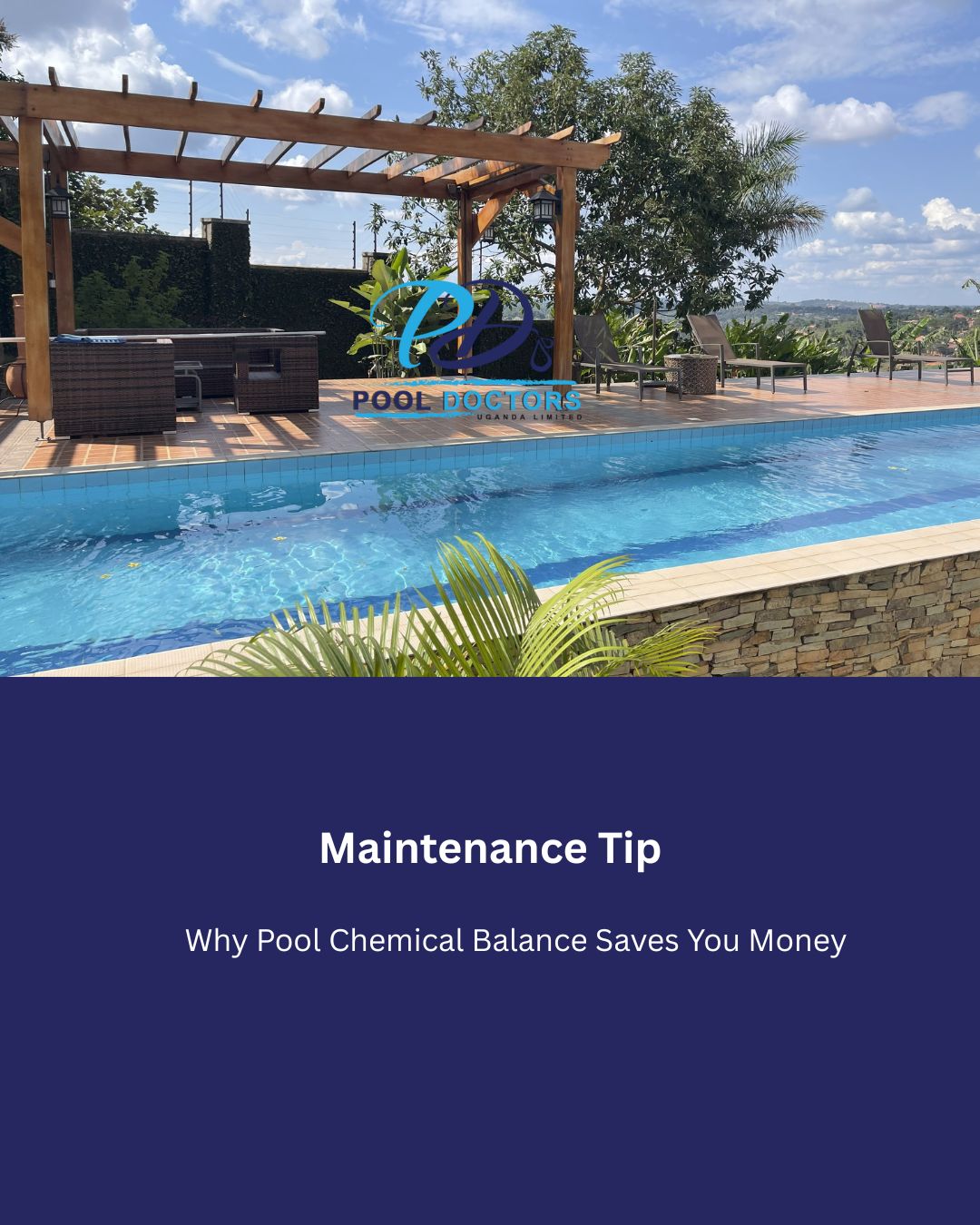
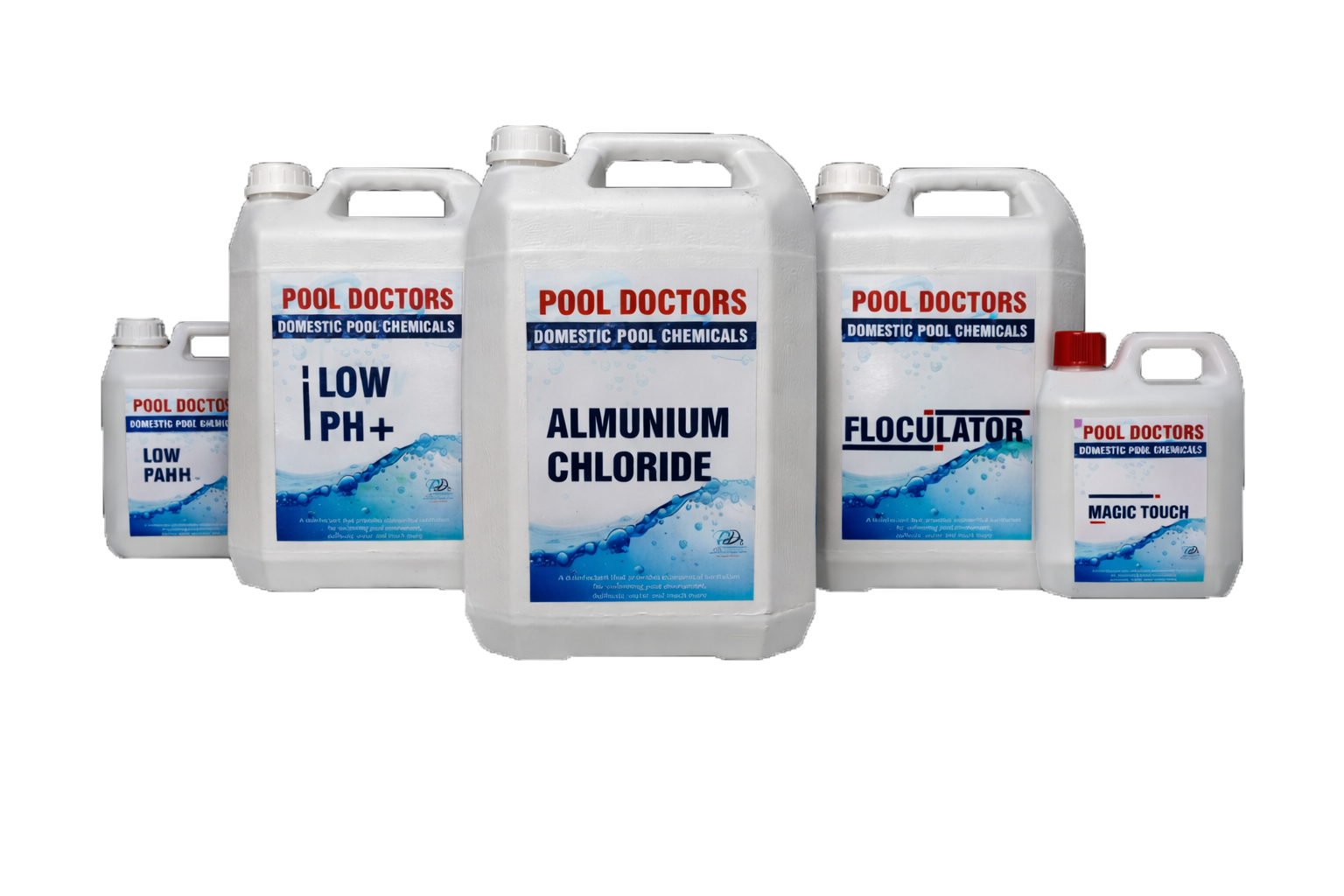
🛠️ Maintenance Tips Maintenance Tip – Why Regular Pool Chemical Balance Saves You Money Long-Term Keeping your pool water balanced isn’t just about clear water — it’s about protecting your investment. Here’s why: 1️⃣ Prevents Costly Repairs – Balanced chemicals protect pool surfaces, tiles, and equipment from corrosion or scaling. 2️⃣ Extends Equipment Life – Pumps, filters, and heaters last longer when water chemistry is right. 3️⃣ Reduces Chemical Waste – Proper balance means you’ll use fewer chemicals over time. 4️⃣ Keeps Water Safe & Healthy – Avoids bacteria growth, algae buildup, and skin irritation. 5️⃣ Saves Money in the Long Run – A small maintenance habit today prevents expensive fixes tomorrow. At Pool Doctors Uganda Limited, we provide: ✅ Pool chemical sales ✅ Professional maintenance services ✅ Consultancy for long-term pool care
Read more
Shopping Cart (0 items)